Change to Preserve the Old Order
The LeopardChange to Preserve the Old Order is the political logic expressed by Tancredi Falconeri when he explains why he is joining the revolutionary movement: change, he argues, may be necessary to prevent a more radical transformation. Don Fabrizio Corbera, Prince of Salina, gradually interprets this as a promise not of social rupture but of managed succession: new men will rise, old families may lose authority, and the underlying order will remain recognizably intact.
Tancredi’s Maxim and Its Immediate Purpose
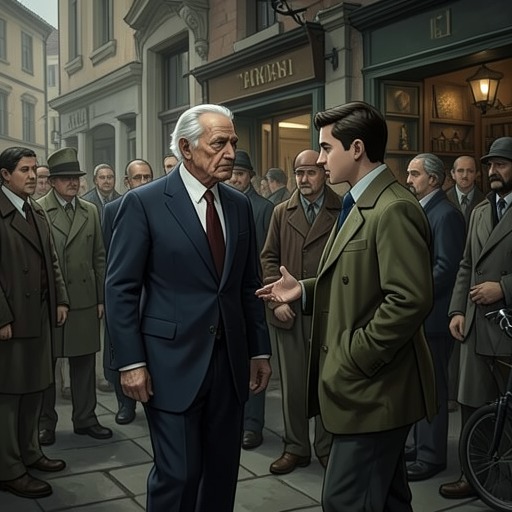
Tancredi gives the maxim while preparing to leave for the hills at Ficuzza. He fears that, unless his side takes action, a republic will be imposed; his intended revolution is therefore presented as a means of preserving what exists by changing who governs. He embraces his uncle and says he will return with the tricolour. The declaration combines political calculation with youthful urgency: Tancredi is leaving home to take part in events, while insisting that action can contain rather than unleash change.
Don Fabrizio initially responds with alarm. He imagines Tancredi caught in a violent skirmish and objects that a Falconeri should support the king. Tancredi’s question about which king unsettles that inherited allegiance, but his appeal to preservation gives Don Fabrizio a way to understand the departure. The maxim thus reframes apparent disloyalty as a strategy for keeping the social world from changing too much.
Don Fabrizio’s Interpretation
After Tancredi leaves, Don Fabrizio connects the maxim to his observations of the political transition. He expects negotiations accompanied by limited shooting, followed by a settlement in which much will change formally while life remains much the same. The image of change without deep transformation becomes more convincing to him as he listens to local figures describe the coming order.
Don Pietro Russo, a dependent of the Salina household, supports the revolutionaries while denying that he is personally involved. He complains of searches, questioning, and police surveillance, and says that honest and capable men should have the opportunity to advance. Yet he also reassures Don Fabrizio that everything else will remain as before. Don Fabrizio reads this combination as the maxim’s practical meaning: the emerging group does not necessarily seek to destroy the old elite, but to take its place.
Class Succession and Continuity
Don Fabrizio imagines the social consequences as a gradual exchange of positions. Russo’s family might acquire aristocratic standing, and Russo’s daughter might marry into the Salina family; these are the Prince’s projections, not events established as having occurred. He likewise pictures Salina titles and honors passing into storage or becoming display pieces, while the family itself could receive compensation or a place in the Sardinian Senate. The old symbols may lose their immediate political function without disappearing from memory or spectacle.
This imagined bargain gives the maxim its sharpest irony. The Salinas may no longer command the same power, yet their name and social standing could survive through accommodation; newcomers may rise, but in doing so adopt the forms of the order they have displaced. Don Fabrizio’s reassurance depends on treating political change as an orderly transfer among classes rather than a transformation of the society’s foundations.
Meaning in the Narrative
The maxim develops from Tancredi’s urgent justification into Don Fabrizio’s broader reading of Sicilian politics. Its force lies in the gap between revolution’s language and the continuity the Prince expects to follow: new authority, new opportunities, and altered public emblems can coexist with familiar hierarchies and habits. The Prince’s interpretation is not a report of a completed settlement; it is his recognition of the logic he believes is already at work.
The idea also links personal and political adaptation. Tancredi’s departure appears to break with his uncle’s royal allegiance, but the maxim makes that break serve a conservative purpose. Later, Don Fabrizio asks Russo to ensure that the girls in Villa Salina are not alarmed, and Russo promises that the house will be quiet. The political upheaval is therefore understood not only through public slogans but through the preservation of domestic calm: the old household may be exposed to change, yet it hopes to pass through it with its essential arrangements intact.